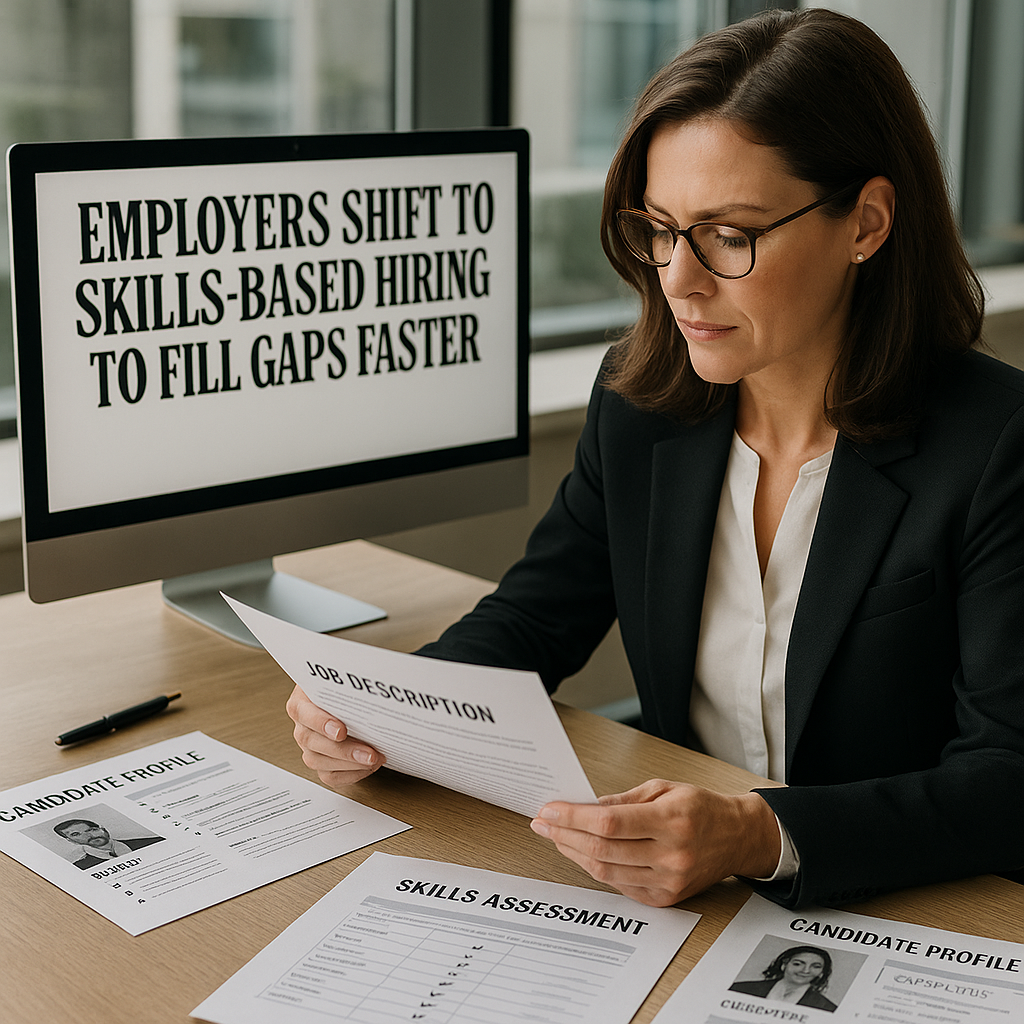
Employers Shift to Skills-Based Hiring to Fill Gaps Faster
Gartner research reveals only 1 in 5 AI investments deliver measurable ROI, forcing employers to refocus on proven hiring strategies. 70% of employers now use skills-based hiring for entry-level roles, prioritizing demonstrated capabilities over credentials to accelerate hiring.
Gartner research published this month reveals that only 1 in 5 AI investments deliver measurable ROI, while 70% of employers have shifted to skills-based hiring for entry-level positions. For Long Island businesses caught between AI promises and hiring realities, this data points to a fundamental mismatch between C-suite expectations and operational needs.
The numbers are stark: Harvard Business Review's 2026 workplace trends analysis shows that while CEO expectations for AI-driven growth remain high, only 1 in 50 AI investments deliver transformational value. Meanwhile, time-to-hire has stretched to 36-44 days, but top candidates are off the market within 10 days - creating an urgent need for faster, more effective recruitment strategies.
For Nassau and Suffolk County employers with 25-200 employees, this creates a critical decision point: continue investing in unproven AI tools or focus resources on skills-based hiring approaches that deliver immediate results in filling open positions.
The AI Investment Reality Check
Peter Aykens, Gartner's distinguished VP and chief of research for HR practice, emphasizes the growing gap between AI hype and reality. Organizations are wasting significant resources on AI initiatives that fail to deliver promised productivity gains, while tolerating performance issues that directly impact their bottom line.
The research reveals that about 25% of the workforce is at least 20% less productive than average, yet most organizations remain remarkably tolerant of low performance. For a 50-employee Long Island medical practice, this could mean 12-13 employees operating significantly below capacity - a productivity drain that costs far more than failed AI experiments.
Small businesses face particular vulnerability because they can't absorb failed AI investments like large corporations. A $50,000 AI implementation that doesn't deliver results represents a much larger percentage of annual revenue for a 30-employee accounting firm than for a Fortune 500 company.
The key insight: rather than chasing transformational AI solutions, successful employers are focusing on identifying the 2% of AI investments that actually deliver measurable value while addressing immediate workforce challenges through proven strategies.
Skills-Based Hiring Gains Momentum
The National Association of Colleges and Employers reports that skills-based hiring has increased to 70% of employers for entry-level positions - up from 65% in 2025. Among employers using this approach, 71% apply skills-based criteria at least half the time, representing a fundamental shift away from degree requirements.
This trend addresses a critical problem for Long Island employers: accessing diverse talent pools to fill positions faster. With 80% of U.S. employers preferring candidates with relevant experience over college graduates, the competitive advantage goes to businesses that can identify and hire skilled workers regardless of educational background.
Professional service firms across Nassau and Suffolk Counties are discovering that skills-based hiring allows them to compete more effectively for talent without large HR departments. A dental practice that requires specific software experience can hire a candidate who learned those systems through previous work experience, even without a formal degree in dental administration.
The approach particularly benefits employers seeking both soft skills (38% priority) and technical skills (37% priority) over credentials. This flexibility becomes crucial when developing hiring processes that can quickly identify candidates capable of contributing immediately rather than requiring extensive training.
Addressing the Productivity Challenge
While organizations focus on AI solutions, Gartner's research highlights a more immediate problem: the 25% of employees operating at significantly reduced productivity levels. For Long Island businesses competing in tight markets, tolerating low performance while investing in unproven technology represents a misallocation of resources.
The solution isn't necessarily terminating underperforming employees - it's implementing systems that identify productivity gaps early and address them through targeted interventions. This might include skills training, role adjustments, or performance improvement plans that help employees reach acceptable productivity levels.
Skills-based hiring contributes to this solution by ensuring new hires can demonstrate required capabilities before starting work. Rather than hoping a degree-qualified candidate will develop necessary skills, employers can verify that candidates already possess the specific abilities the role requires.
For small businesses, this approach reduces the risk of hiring mistakes that create long-term productivity drains. A 15-employee law firm that hires based on demonstrated legal research skills rather than law school rankings is more likely to add productive capacity immediately.
The Speed Advantage
Current hiring timelines work against employers in competitive talent markets. While average time-to-hire has stretched to 36-44 days, the best candidates are typically off the market within 10 days. Skills-based hiring can significantly accelerate this timeline by focusing on demonstrable abilities rather than credential verification.
Employers using skills-based approaches report faster decision-making because they can assess candidates through practical demonstrations, portfolio reviews, or skill-specific interviews rather than waiting for background checks on educational credentials or previous employer references.
This speed advantage becomes critical for Long Island businesses competing with New York City employers who may offer higher salaries but longer commutes. A Nassau County accounting firm that can make hiring decisions within a week while maintaining quality standards gains significant competitive advantage over slower-moving competitors.
Practical Implementation for Long Island Employers
Successful skills-based hiring requires restructuring job descriptions, interview processes, and evaluation criteria. Instead of listing degree requirements, job postings should specify required skills and provide ways for candidates to demonstrate those abilities.
Key implementation steps include:
- Skill-focused job descriptions: Replace education requirements with specific capability requirements and assessment methods
- Practical assessments: Use work samples, skill demonstrations, or trial projects to evaluate candidate abilities
- Competency-based interviews: Focus questions on how candidates have applied relevant skills in previous situations
- Pay transparency: Clear salary ranges help attract candidates who might otherwise assume they're unqualified
However, implementing these changes effectively often requires professional guidance to ensure that assessment methods accurately predict job performance while remaining legally compliant and fair to all candidates.
Balancing AI Investment with Hiring Needs
The research doesn't suggest abandoning AI entirely - it recommends realistic expectations and strategic focus. Rather than pursuing transformational AI solutions, successful employers are identifying specific, measurable applications where AI can deliver clear value.
For hiring, this might mean using AI tools for resume screening or interview scheduling while maintaining human judgment for final selection decisions. The goal is enhancing human capabilities rather than replacing human decision-making in critical areas like hiring and employee management.
Long Island businesses should prioritize AI investments that address specific operational challenges with measurable outcomes rather than pursuing broad AI strategies that promise undefined productivity improvements. A medical practice might benefit from AI-assisted appointment scheduling but see no return on AI-powered diagnostic tools that require extensive training and integration.
The Competitive Advantage Window
Q1 2026 represents a critical period as organizations reassess both AI strategies and hiring approaches. The 5% year-over-year increase in skills-based hiring indicates accelerating adoption, while the gap between AI expectations and reality creates workforce uncertainty that smart employers can address.
Businesses that move quickly to implement skills-based hiring while setting realistic AI expectations will outperform competitors still chasing transformational technology solutions or maintaining outdated degree-based hiring requirements.
The key is recognizing that workforce challenges require immediate, practical solutions rather than waiting for AI tools to mature. Skills-based hiring provides proven results now, while AI investments should focus on specific applications with clear, measurable benefits.
For Long Island employers struggling to fill positions in a competitive market, having experienced support to implement faster hiring processes can mean the difference between capturing top talent and watching them accept offers from more agile competitors.
The organizations that thrive in 2026 won't be those that adopt the most AI tools - they'll be those that solve immediate workforce challenges while making strategic technology investments that actually deliver measurable value.
Employers with questions about implementing skills-based hiring strategies can reach us at info@bentonoakfield.com.
This content is for informational purposes only and does not constitute legal, tax, or benefits advice. Requirements vary based on employer size, location, and plan structure. Information is current as of 2026-02-18. Employers should consult qualified advisors for guidance on their specific circumstances.