When Companies Built Entire Communities for Workers
In the early 1900s, industrial giants created entire towns to house and support workers, pioneering a radical approach to employee welfare that transformed American labor relations.
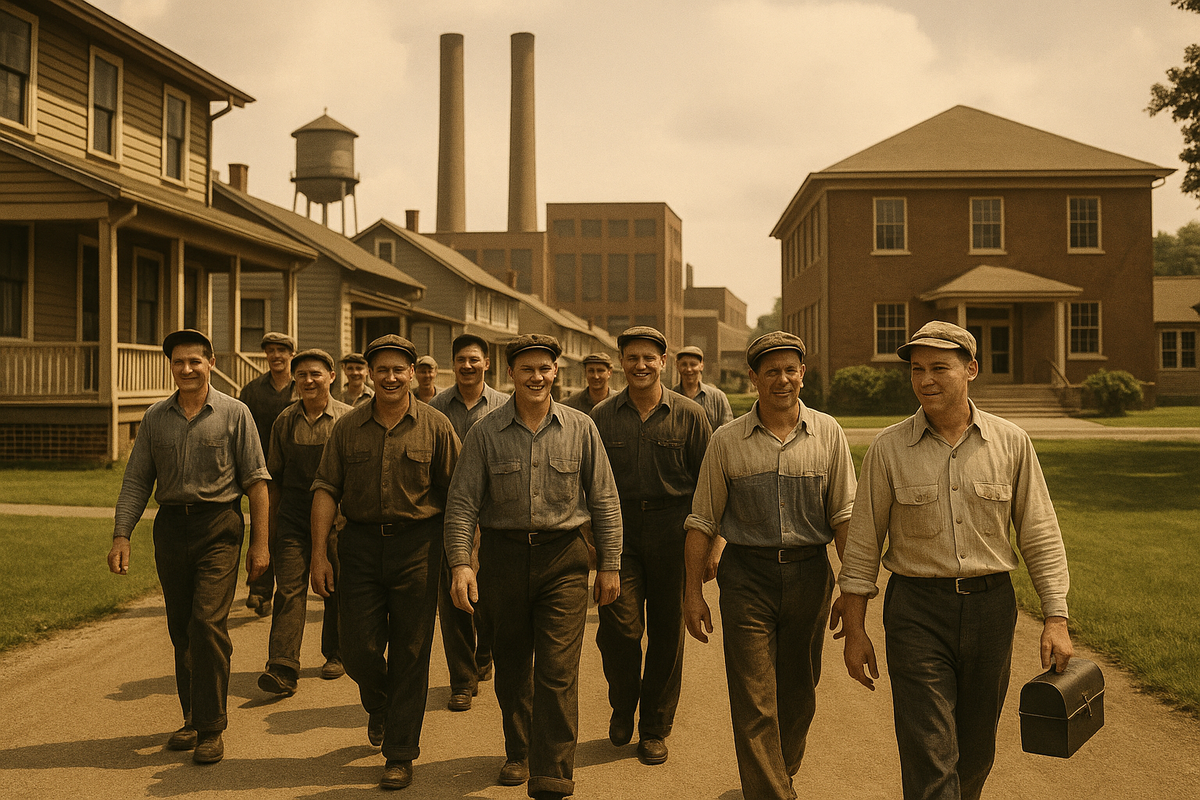
Picture this: It's 1890, and the American Industrial Revolution is transforming the nation at breakneck speed. Steam-powered factories are sprouting across the landscape, railroad networks are connecting distant regions, and millions of workers are flocking to industrial centers in search of steady employment. But in the remote mining valleys of Pennsylvania and the emerging manufacturing districts of the Midwest, a remarkable experiment is taking shape—one that would redefine the relationship between American employers and their workers for generations to come.
Industrial giants like the Pullman Company in Illinois and the Hershey Chocolate Company in Pennsylvania weren't just building factories—they were constructing entire communities from the ground up. These "company towns" represented a radical departure from traditional employment relationships, where employers provided not just jobs but complete living environments: housing, schools, churches, hospitals, libraries, and recreational facilities.
This wasn't merely corporate philanthropy. It was a calculated business strategy that would pioneer the concept of comprehensive employee welfare, laying the groundwork for the modern benefits systems that today's Long Island employers use to attract and retain skilled workers across Nassau and Suffolk Counties.
The Birth of Industrial Paternalism
The company town movement emerged from a convergence of practical business needs and progressive social ideals during the height of America's industrial expansion from 1880 to 1930. As factories grew larger and more complex, employers faced unprecedented challenges in securing and maintaining stable workforces capable of operating sophisticated machinery and meeting demanding production schedules.
Traditional labor markets were proving inadequate for these new industrial realities. Workers were highly mobile, moving frequently between employers in search of better wages or working conditions. High turnover rates disrupted production, increased training costs, and made it difficult to develop the skilled workforce that modern manufacturing required.
The solution that emerged was revolutionary in its scope and ambition. Rather than simply offering higher wages to compete for workers, visionary employers began creating comprehensive living environments designed to meet every aspect of their employees' needs. The Library of Congress documents how these company towns represented "a new form of industrial organization that sought to create ideal communities for workers and their families."
These weren't haphazard collections of worker housing. Company towns were carefully planned communities that reflected their employers' vision of ideal worker life. Streets were laid out in orderly grids, houses were designed to promote family stability, and community facilities were strategically located to encourage social interaction and civic engagement.
The Comprehensive Welfare Model
What made company towns truly revolutionary was their comprehensive approach to employee welfare. Employers didn't just provide jobs—they created complete social ecosystems designed to support every aspect of worker life.
Housing was typically the centerpiece of these communities. Companies constructed thousands of worker homes, ranging from modest cottages for entry-level employees to substantial houses for supervisors and managers. These weren't temporary barracks but permanent residences designed to encourage workers to put down roots and build stable family lives.
Education was another crucial component. Company towns typically featured well-funded schools that often provided better education than was available in surrounding rural areas. Some employers went further, establishing technical training programs, libraries, and even colleges to develop their workforce's skills and knowledge.
Healthcare services were revolutionary for their time. Company towns often featured hospitals, clinics, and medical staff that provided care far superior to what was available in most American communities. This wasn't just humanitarian—healthy workers were more productive workers, and comprehensive medical care reduced absenteeism and workplace accidents.
Recreation and social facilities completed the picture. Company towns featured parks, athletic facilities, community centers, theaters, and churches. These amenities weren't just perks—they were designed to create social bonds that would tie workers to the community and reduce turnover.
Long Island's Industrial Evolution
While the classic company towns of the Industrial Revolution were primarily located in mining and heavy manufacturing regions, the principles they established would prove crucial for Long Island's economic development in the decades that followed. As Nassau and Suffolk Counties began attracting major industrial employers in the early 20th century, the lessons learned from company town experiments informed new approaches to workforce development and employee relations.
Companies like Grumman Aircraft Corporation, which would eventually establish its massive Bethpage facility, inherited the welfare capitalism traditions that company towns had pioneered. The aerospace industry's need for highly skilled engineers, technicians, and craftsmen made employee retention particularly critical, and comprehensive support systems became essential tools for building stable workforces.
Republic Aviation in Farmingdale and other Long Island manufacturers found that creating supportive work environments—while not necessarily building complete company towns—helped them attract skilled workers from other regions while building loyalty among local employees. The investment in comprehensive employee support systems supported the region's transformation from agricultural communities to industrial centers.
The company town model also established important precedents for employer-community relationships that would influence Long Island's business culture for generations. Companies that embraced comprehensive worker support often developed reputations as desirable employers, creating competitive advantages that extended far beyond immediate compensation packages.
The Psychology of Industrial Paternalism
The company town movement represented more than just an innovative business strategy—it embodied a particular philosophy about the relationship between employers and workers that would profoundly influence American labor relations. This approach, known as "industrial paternalism," viewed employers as benevolent father figures responsible for their workers' comprehensive well-being.
From the employers' perspective, this model offered several advantages. Workers who lived in company housing, sent their children to company schools, and received medical care from company doctors were less likely to leave for other opportunities. The comprehensive nature of company town life created multiple ties that bound workers to their employers in ways that simple wage relationships could not.
The model also provided employers with significant control over their workforce. Company towns typically featured rules governing everything from alcohol consumption and gambling to political activities and social behavior. Workers who violated these rules could find themselves not just unemployed but homeless, as company housing was tied to continued employment.
Yet for many workers, company towns represented genuine improvements in living standards and opportunities. Social welfare historians note that company town residents often enjoyed better housing, education, and healthcare than was available in surrounding communities, along with recreational and cultural amenities that would have been unimaginable in traditional industrial settings.
The Economic Logic of Comprehensive Benefits
While company towns were often criticized as paternalistic or controlling, their economic logic was compelling and would influence employee benefits thinking for decades to come. Employers discovered that comprehensive worker support systems often paid for themselves through reduced turnover, improved productivity, and enhanced worker loyalty.
The costs of constantly recruiting and training new workers were substantial, particularly in industries that required significant skill development. Company towns reduced these costs by creating environments where workers wanted to stay, building career-long employment relationships that benefited both employers and employees.
The comprehensive nature of company town benefits also created economies of scale that made individual services more affordable. Group purchasing of medical care, bulk provision of housing, and shared recreational facilities could provide higher-quality amenities at lower per-worker costs than individual workers could afford on their own.
Perhaps most importantly, company towns demonstrated that comprehensive employee benefits could create competitive advantages in attracting skilled workers. Communities that offered superior housing, education, and healthcare could recruit talent from across the country, building workforces that might otherwise have been impossible to assemble.
The Decline and Transformation
The classic company town model began to decline after 1930, undermined by changing economic conditions, labor union organizing, and evolving social attitudes about employer-employee relationships. The Great Depression made the paternalistic model seem less benevolent as companies cut benefits and closed facilities. World War II labor shortages gave workers more mobility and bargaining power, reducing their dependence on company-provided amenities.
Labor unions were particularly critical of company towns, viewing them as tools for controlling workers and preventing organizing activities. The rise of collective bargaining created alternative mechanisms for workers to secure benefits and protections, reducing the appeal of employer paternalism.
However, the fundamental insights that company towns had generated about comprehensive employee benefits didn't disappear—they evolved. The post-war period saw the emergence of modern employee benefits systems that incorporated many company town innovations while adapting to new economic and social realities.
Employer-sponsored health insurance, retirement plans, and educational assistance programs all traced their roots back to company town experiments. The difference was that these benefits were now portable and governed by collective bargaining agreements or federal regulations rather than employer discretion.
Modern Relevance for Today's Employers
For Long Island employers today, the company town experience offers valuable insights into the strategic use of comprehensive employee benefits. While modern businesses don't build entire communities for their workers, the principles that made company towns successful remain relevant for contemporary HR strategy and policy development.
The company town emphasis on addressing workers' comprehensive needs—not just immediate compensation—provides a model for modern benefits programs that support employee retention and engagement. Companies that invest in health insurance, retirement planning, professional development, and work-life balance often see returns similar to what company town employers experienced a century ago.
The community-building aspects of company towns also offer lessons for modern workplace culture development. Employers who create strong workplace communities—through team-building activities, social events, and shared goals—often achieve the loyalty and engagement that company towns generated through physical community design.
The company town experience also demonstrates the importance of viewing employee benefits as integrated systems rather than isolated programs. The most successful company towns provided comprehensive support that addressed multiple aspects of worker life, creating synergies that enhanced the value of individual benefits.
Lessons for Today's Business Leaders
The story of company towns offers important insights for contemporary business leaders navigating competitive labor markets and employee retention challenges. While the paternalistic aspects of company towns are no longer appropriate or effective, the underlying principles of comprehensive employee support remain valuable.
The company town emphasis on long-term relationship building provides a model for modern approaches to talent management and employee engagement. Companies that invest in their workers' long-term success—through career development, skills training, and comprehensive benefits—often achieve the stability and loyalty that company towns created through community ownership.
The integration of work and community life that characterized company towns also offers insights for modern workplace design and culture development. While employees no longer want employers controlling their entire lives, they do value workplaces that support their broader life goals and provide meaningful community connections.
For today's Long Island employers, the company town legacy suggests that comprehensive employee support creates competitive advantages that extend far beyond immediate recruitment and retention benefits. Companies that demonstrate genuine commitment to employee well-being often develop reputations that support broader business objectives including customer relations, community partnerships, and long-term growth.
The evolution from company towns to modern benefits systems also illustrates the importance of adapting employee support programs to changing social and economic conditions. The most successful approaches balance comprehensive support with employee autonomy, creating benefits that enhance rather than control worker lives.
Building on Historical Foundations
As Nassau and Suffolk Counties continue to evolve economically, with new industries emerging alongside traditional aerospace and manufacturing employers, the lessons of company towns remain relevant. The emphasis on comprehensive employee support, community building, and long-term relationship development provides a framework for addressing contemporary workforce challenges.
Modern workplace issues—from student loan debt and childcare needs to mental health support and flexible work arrangements—require the same innovative thinking that led to company town development. The most successful contemporary approaches often combine traditional benefits like health insurance and retirement plans with creative solutions to emerging workforce needs.
The company town model also demonstrates the value of viewing employee benefits as investments in organizational capability rather than simply as costs to be minimized. Companies that embrace this perspective often find that comprehensive benefits programs support broader business objectives including innovation, customer service, and market competitiveness.
Today's employers can apply the systematic approach that made company towns successful to contemporary benefits planning. Just as company town developers considered housing, education, healthcare, and recreation as integrated elements of worker support, modern employers can design benefits programs that address multiple aspects of employee well-being in coordinated ways.
The historical success of company towns also illustrates the importance of understanding employee needs and motivations when designing workplace programs. The most effective company towns were those that genuinely addressed worker concerns about housing, education, and community life, creating value that employees recognized and appreciated.
The legacy of company towns continues to influence how American employers think about their relationships with workers. The shift from simple wage relationships to comprehensive support systems that began in the 1890s has evolved into contemporary concepts like employee engagement, total rewards, and human capital development—all of which build upon the fundamental insight that comprehensive employee support creates value for both workers and employers.
Ready to build on the strong historical foundation of comprehensive employee support by developing modern benefits programs that attract top talent while supporting your business objectives? Contact Benton Oakfield today to discuss how expert guidance can help you navigate today's complex NY Labor Laws and Workplace Regulations while creating employee support systems that honor the best traditions of comprehensive worker welfare while addressing the contemporary needs of your Long Island workforce.
This article is for informational purposes only and does not constitute legal or tax advice. Consult with qualified professionals for guidance specific to your situation.