When Companies Started Counting Tomorrow's Healthcare Bills Today
The 1980s revolution in accounting standards that forced American employers to face the true cost of retiree health benefits and changed corporate America forever.

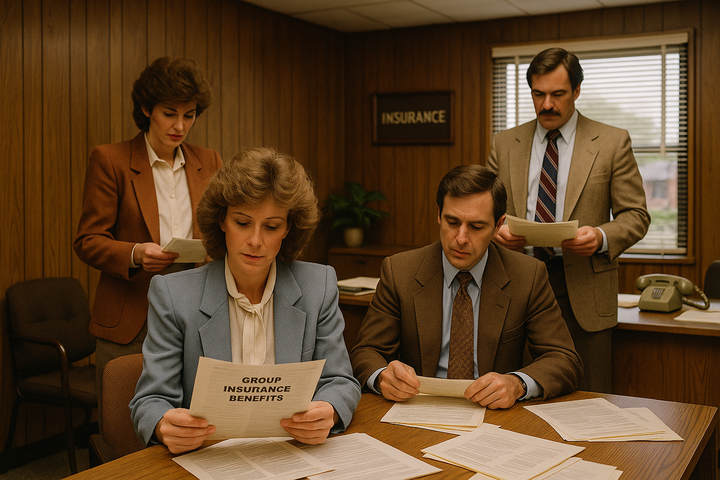
Picture this: It's 1985, and a Fortune 500 manufacturing company's CFO is reviewing the quarterly financials. The numbers look solid—profits are up, shareholders are happy. But lurking in the shadows is a financial obligation that won't appear on any balance sheet for years to come: the healthcare costs of thousands of workers who will retire over the next two decades. This invisible debt, multiplied across corporate America, represented one of the largest unaccounted liabilities in business history.
The 1980s marked a pivotal decade when American accounting standards finally caught up with a reality that had been building since the post-war boom: employers were making healthcare promises to future retirees without properly accounting for these commitments. The Financial Accounting Standards Board (FASB) was about to change all that with a series of groundbreaking standards that would fundamentally reshape how companies thought about employee benefits.
The Hidden Promise Economy
Throughout the 1960s and 1970s, American companies had embraced an innovative approach to employee retention and recruitment: promising comprehensive healthcare coverage that would extend well into retirement. It seemed like a win-win proposition. Companies could attract top talent with generous benefit packages, and the actual costs wouldn't hit the books until decades later when those employees actually retired and started using their healthcare benefits.
This creative financing approach worked beautifully in an era of steady economic growth and predictable healthcare costs. General Motors, Ford, IBM, and countless other major employers built their workforce strategies around these long-term benefit commitments. The accounting was simple: pay-as-you-go. When a retiree needed medical care, the company wrote a check. No need to estimate future costs or set aside reserves.
But by the early 1980s, two powerful forces were converging to make this approach increasingly problematic. Healthcare costs were accelerating at an unprecedented pace, and the post-war generation was approaching retirement age. The bills were coming due, and they were bigger than anyone had anticipated.
FASB Steps Into the Future
The Financial Accounting Standards Board, established in 1973 as the primary standard-setter for financial accounting in the United States, recognized that American businesses were operating with a significant blind spot. Companies were making long-term financial commitments without reflecting these obligations in their financial statements. This wasn't just an accounting technicality—it was a transparency issue that affected investors, creditors, and the companies themselves.
In the mid-1980s, FASB began developing what would become one of its most consequential standards: rules requiring companies to account for postretirement benefits other than pensions—primarily healthcare benefits—using actuarial methods that would estimate and record the present value of future obligations.
This represented a revolutionary shift in thinking. Instead of the simple pay-as-you-go approach, companies would need to calculate the projected cost of providing healthcare to current employees throughout their retirement years, then spread that cost over the employees' working careers. It was actuarial science applied to corporate America on a massive scale.
The Great Reckoning
The implementation of these new standards in the late 1980s created what can only be described as a moment of truth for American corporations. Suddenly, companies had to confront the mathematical reality of their healthcare promises. The numbers were staggering.
Take early retirement packages, which had become increasingly popular as companies sought to reduce their workforce during economic downturns. Under the old accounting methods, offering healthcare coverage to a 55-year-old early retiree until they became eligible for Medicare at 65 seemed like a manageable ten-year commitment. Under FASB's new standards, companies had to account for the full actuarial cost of that benefit immediately, recognizing that healthcare inflation could make those ten years of coverage far more expensive than initially projected.
This accounting innovation forced a fundamental recalculation of the true cost of employment. Companies discovered that their actual labor costs were significantly higher than their financial statements had reflected. The new standards didn't change the underlying economic reality—the obligations had always existed—but they made that reality visible in a way that transformed corporate decision-making.
Innovation Through Necessity
Rather than simply absorbing these newly visible costs, American businesses responded with characteristic ingenuity. The late 1980s saw an explosion of creative benefit design solutions. Companies began experimenting with health savings accounts, retiree premium sharing, and more sophisticated insurance arrangements that could help manage long-term healthcare cost exposure.
Some employers pioneered innovative approaches to early retiree coverage, creating bridge insurance programs that provided temporary coverage until Medicare eligibility. Others developed tiered benefit systems that adjusted coverage levels based on years of service or retirement age, allowing for more precise cost management while still providing meaningful benefits.
The Legacy of Transparency
Looking back from today's vantage point, the FASB standards of the 1980s represent a crucial turning point in American healthcare history. By forcing companies to account for the true cost of their healthcare promises, these accounting innovations set in motion changes that continue to shape employee benefits today.
The transparency created by proper accounting didn't eliminate retiree health benefits, but it did make them more sustainable. Companies that understood their long-term obligations could plan more effectively, set aside appropriate reserves, and design benefit programs that balanced employee needs with financial reality.
Today's complex landscape of employer-sponsored health insurance, with its emphasis on cost-sharing, consumer-directed benefits, and carefully managed networks, can trace its origins back to those pivotal moments in the 1980s when American businesses first began counting tomorrow's healthcare bills today. The accounting revolution of that decade didn't just change how companies reported their finances—it fundamentally transformed how America thinks about the relationship between work, retirement, and healthcare.